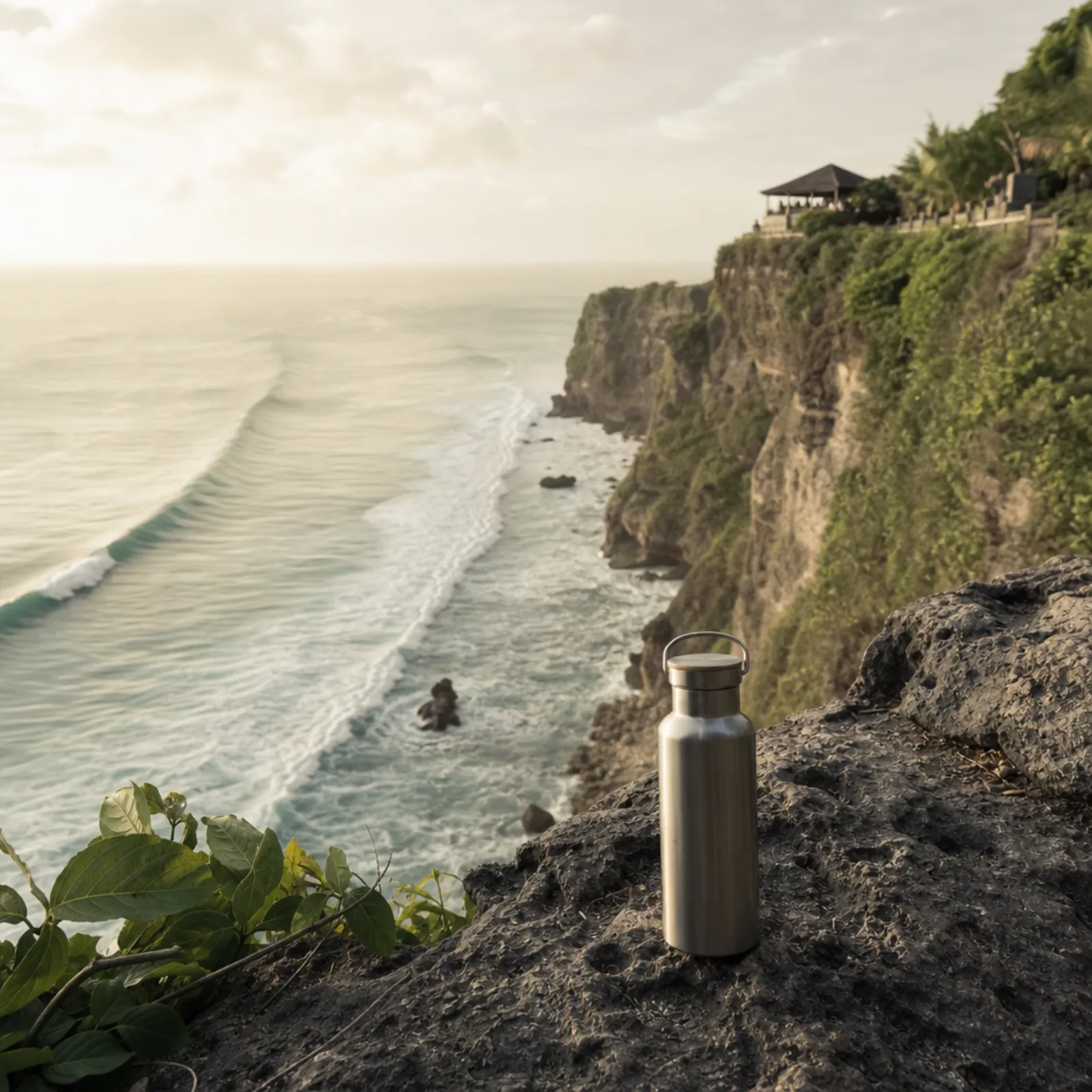
A limestone cliff line on Bali's southern peninsula, home to one of the most photographed reef breaks in surfing, and — a plain fact worth stating — no indigenous Chinese tea tradition of its own.
The wave
Uluwatu sits at the southern tip of Bali’s Bukit peninsula, a limestone headland capped by a cliffside temple, Pura Luhur Uluwatu, that’s stood watch over the break for centuries. The wave itself is a left-hand reef that fires along a series of named sections — Racetracks, Outside Corner, Temples — depending on the swell and tide. It’s one of the most consistent, most surfed, and most written-about waves in Indonesia, which also means it’s crowded on any decent day. The dry season, roughly April through October, is when the swell window is most reliable and the cliffside warungs fill up with boards leaning against every railing.
Getting down to the water means a walk through a cave carved into the cliff face — a strange, cool, damp transition from motorbike traffic to open ocean in about ninety seconds. It’s one of the more theatrical paddle-outs in surfing.
The tea note
Bali’s own drink culture runs on coffee and on the small offerings — canang sari — left at every doorway and temple step, not on Chinese tea. We’re not going to invent a tea house on the cliff that doesn’t exist. What we’d actually pack here is the same as anywhere without a local Chinese tea tradition: a short, low-caffeine pour before the dawn walk through the cave, from whatever’s in the travel kit, because the point of this ritual was never that it belongs to Uluwatu — it’s that it travels with you to a place that has its own, entirely separate tea and coffee culture worth respecting on its own terms.