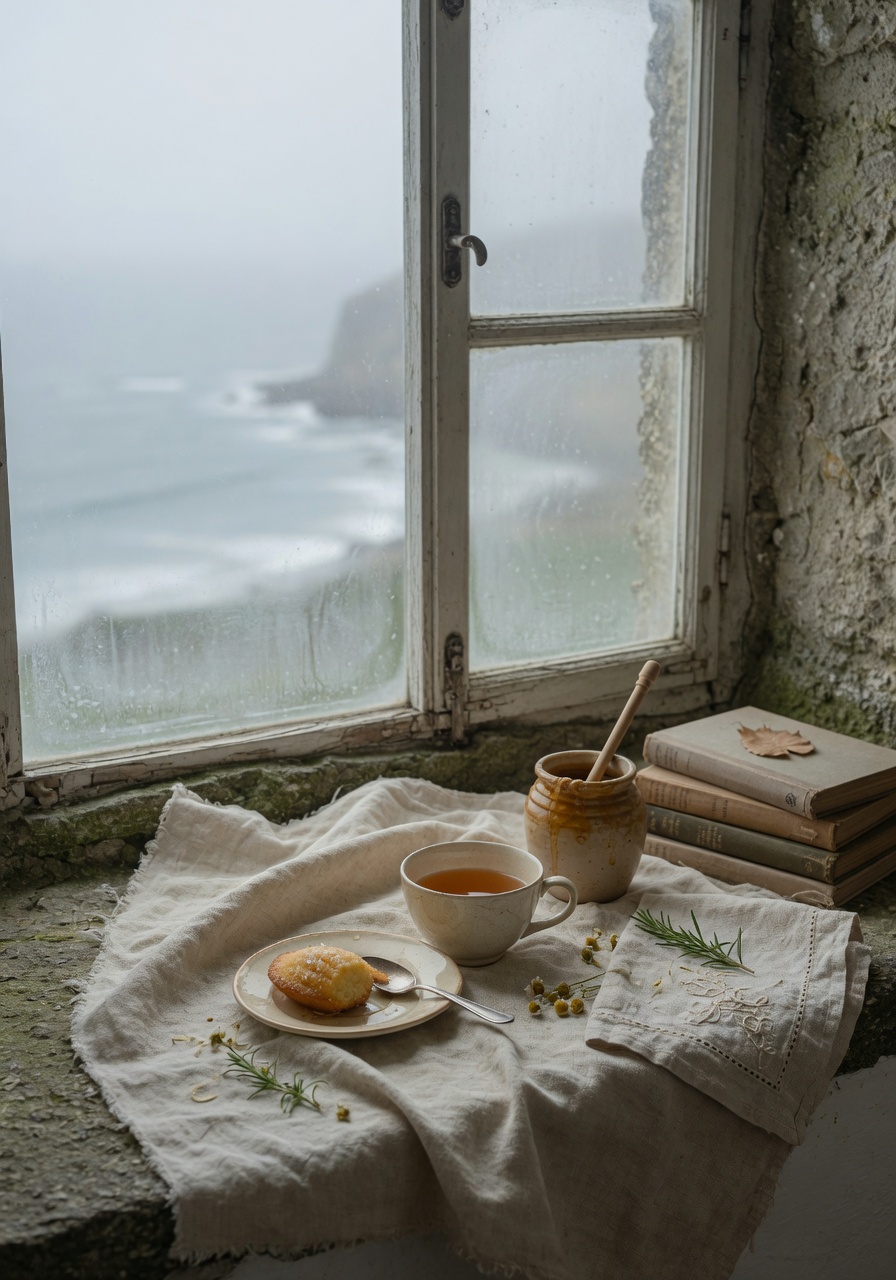
A three-bedroom stone house above São Lourenço point, with a basement cellar of ageing sheng pu'er and a tea room that opens to the swell line. Six guests, three named teas in residence.
A stone house, a cellar, a point break
The house sits four hundred metres above São Lourenço, on a lane that ends in gorse and basalt. From the road it is unremarkable — whitewashed stone, blue shutters faded to the colour of a winter sea, a slate roof patched twice since the 1970s. The door is heavy and slightly out of true. You shoulder it open and the Atlantic arrives in the same breath as the smell of old wood and ageing tea.
Three bedrooms upstairs, each with a single window framing a different fragment of coast. The largest looks south to the point — on a clean north swell you can read the lines from bed, count the sets, decide whether to dress. The tea room occupies what was once the front parlour: a low table of weathered chestnut, six tatami cushions, a kettle on a small charcoal brazier in the corner. The window is single-glazed and rattles in onshore wind. Nobody has wanted to replace it.
The cellar is the reason the house exists in its current form. Amgalan Chin took the lease in 2021 specifically for the basement — a dry, stone-walled room two metres below the lane, holding steady at fourteen degrees through summer and twelve in winter, with the slow salt humidity of the Atlantic seeping through the walls at a rate he had measured for a year before he signed. Sheng pu’er from Bulang and Yiwu ages here on cedar shelves, the cakes wrapped in their original cotton paper, dated in pencil on the corner. Some have been here three years. Some were carried over from his cellar in Buryatia and have been ageing eleven. Guests are welcome in the cellar in stockinged feet and quiet voices. The wrappers are read like a library.
Amgalan is in residence from October through April, the cold-water season, when the swell is consistent and the house is full. His morning is not negotiable. Five-forty alarm, kettle on, a single cup of last year’s Bīng Dǎo (冰岛) sheng while the light grows in the kitchen window. Surf check at six-fifteen from the headland — a black silhouette in a hooded parka, thermos in hand. Paddle-out at first light if the wind holds offshore. By nine he is back at the house, hair still wet, brewing the first session of the day for whoever has come downstairs. He writes about ageing on puerh.app between sessions, in a small notebook he keeps in the tea room, and answers letters from students on tea.school in the afternoon when the wind turns onshore and the surf goes to pieces.
The kitchen is small and well-stocked. A cast-iron stove that takes an hour to warm the house in January. A long table that seats eight if two are willing to share a bench. The fridge holds whatever Maria from the cooperative at Ribamar has brought up that morning — sardines in winter, sea bass, samphire from the cliffs, eggs from a neighbour who keeps four hens behind the church. Breakfast is included; lunch is on your own; dinner is communal three nights a week, cooked by whoever volunteers, eaten slowly.
Downstairs again, off the tea room, a small mud-room takes wetsuits. There is a wooden bench, six brass hooks, a hose with warm water plumbed from the boiler, and a rack for boards. The smell here is neoprene and rinse-water and faintly, drifting through the wall, the cedar of the cellar next door. It is a particular smell. You will remember it.
The surrounding environment is São Lourenço, Coxos, Ribeira d’Ilhas — three of the best right-handers in Europe, all within fifteen minutes by car or twenty-five on the cliff path. The wind is reliable, the water is cold, the locals are patient if you are patient first. The house keeps two longboards and two performance shortboards in the rack, all Portuguese-shaped, all repaired more than once. Bring your own if you are particular. Most guests aren’t, by the third morning.
Booking is for the whole house, six guests maximum, three nights minimum. We do not split rooms between unrelated parties. The point of the house is the table and the cellar and the slow week.
Three teas in residence, two sessions a day
Each season Amgalan selects three teas to keep in the front of the cellar — the residence teas, served at every session, decanted into small unglazed jars on the tea room shelf. The selection rotates with the swell calendar and with what has come of age in the cellar. For winter 2026 the residence holds a 2014 Bulang sheng from a village above Mengsong, a 2019 Yiwu Mán Sōng (曼松) area sheng pressed in a 200g cake, and a Wò Duī (渥堆) shou from his own production in collaboration with a small Menghai factory, fermented in 2020 and now drinking with the quiet sweetness of damp forest floor and dried date.
Two sessions are offered each day. The morning session begins at nine-thirty in the tea room, after Amgalan has come in from the water. It is shorter and lighter — usually the Bulang or the Yiwu, brewed in a thin-walled gaiwan, four to six infusions, conversation held low because the house is still waking. The afternoon session begins at four, when the onshore wind has set in and the surf is finished for the day. This is the long session — ninety minutes minimum, often two hours, sometimes the shou pu’er from a clay pot Amgalan has used for seven years, sometimes a tea pulled from the back of the cellar for a particular guest or a particular question.
The room seats six on tatami. Amgalan brews; guests watch the kettle, the pour, the lid of the gaiwan, the colour of the soup deepening in the fairness cup. He speaks if asked, and otherwise lets the tea do the work. There is no curriculum, no certificate, no tasting sheet. If you want structured study, he refers you to tea.school, where he teaches a winter intensive on sheng ageing. If you want to take a cake home, the cellar list is on shop.puerh.app and he will pull anything from the shelf and seal it for you at cost plus a small handling charge.
One evening per stay — usually the last clean evening of the swell window — there is a longer sitting after dinner, by candlelight, with whatever shou or aged sheng Amgalan feels the week has earned. This is not advertised and not scheduled. It happens when it happens. Bring socks. The stone floor is cold.
Amenities
-
Three bedrooms, six beds, two bathrooms with deep cast-iron tubs
-
Tea room seating six on tatami, charcoal brazier, single-glazed sea window
-
Basement ageing cellar with cedar shelving, climate-stable year-round
-
Wetsuit mud-room with warm rinse hose and board rack for six
-
House quiver — two longboards, two shortboards, Portuguese-shaped
-
Cast-iron wood stove, fully stocked kitchen, long communal table
-
Cliff-path access to São Lourenço point in under ten minutes on foot
-
Wood-fired sauna in the garden shed, lit on request
What’s included
-
Two daily tea sessions with Amgalan Chin, October–April residency
-
Breakfast each morning and three communal dinners per week
-
Full access to the house quiver, wetsuit rinse, and sauna
-
Cellar visits by appointment and cake purchasing at cellar cost
-
Airport pickup from Lisbon for stays of five nights or longer
-
A printed swell and tide forecast each evening for the next day