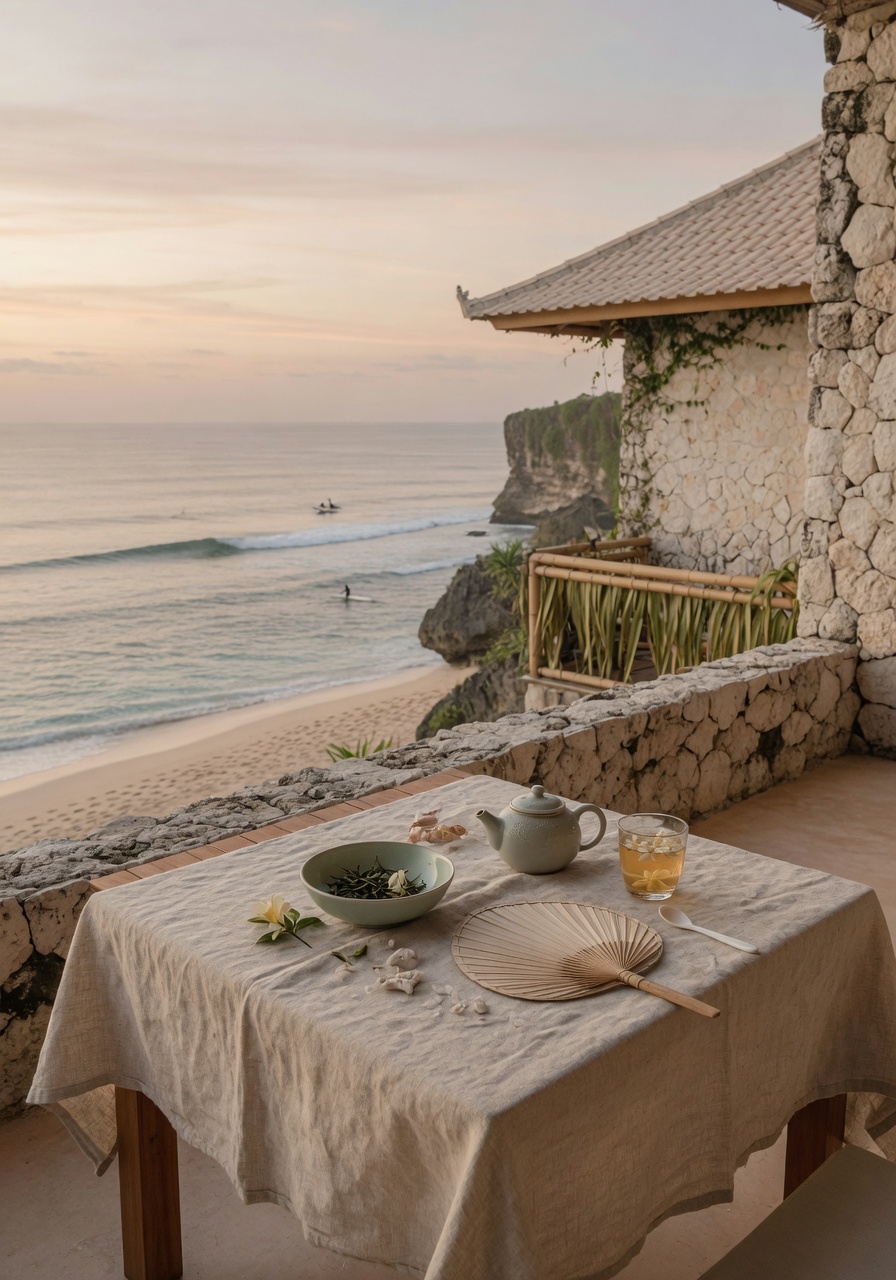
Four bedrooms above Padang Padang, six guests at most, and a 15-mat tea room held by resident master Fang Ting. Mornings on the wave, afternoons on the gaiwan.
A house built around two rooms — the ocean and the tea table
Villa Yiwu sits on the limestone shelf above Padang Padang, close enough that the long lefts are audible from the kitchen and the spray catches the lower terrace on a serious south swell. The name is borrowed from Yiwu (易武) in Yunnan, the village whose old-tree pǔ’ěr cakes line the cabinet in the main room — a quiet acknowledgement that two of Bali’s defining things, the wave and the leaf, both come down from mountains.
The house is four bedrooms and sleeps six. We keep it that way on purpose. A surf villa with twelve guests and a buffet is a different proposition; Yiwu is built for a small group who want the same wave at dawn and the same tea table at four. Three of the bedrooms open onto the cliff, one onto the frangipani courtyard, and all of them have outdoor showers walled in volcanic stone. Boards live in a teak rack by the path down to the beach. The keys to the scooters hang next to the kettle.
The centre of the villa is the tea room — fifteen tatami mats, paper screens that slide back to a view of the channel, and a tokonoma where the week’s tea cake rests on its wrapper before it is broken. Seating is for eight, which means the tea programme is never crowded even when the house is full. Fang Ting, our resident master, keeps her tools on a low cypress board: a Yixing pot the colour of wet clay, three gaiwan in different sizes, a kettle on a small charcoal brazier when the air is dry enough to allow it. She arrived at tea through Henan greens and oolong, then spent years on pǔ’ěr — the same cross-category fluency she brings to her cupping notes on puerh.app. Guests who want to follow her writing or order leaf to take home find her shelf at shop.puerh.app stocked with cakes she has personally pressed for.
Her day at the villa is shaped by the surf forecast more than by a fixed timetable. On a dawn-patrol morning, the kettle is already on at five — a small pot of light Henan oolong before the walk down to the beach, the kind of cup that wakes the body without rattling it. The science behind why this works — caffeine slowed by L-theanine into a long, even line rather than a spike — is something we have written about in detail on the constellation’s energy notes, and the Pre-surf, Intra-surf, Post-surf protocols on this site map directly to the rhythms of the house. After the morning session, breakfast is fruit, eggs, congee if anyone asks for it, and a fresh pot of cooler-brewed green to rehydrate.
Afternoons belong to the tea room. Fang Ting holds one structured session a day, usually at four, when the cliff is in shade and the light through the paper screens turns the colour of soaked Bái Háo Yín Zhēn (白毫银针). The session might be a vertical of three Yiwu cakes across a decade, or a side-by-side of a Mí Lán Xiāng (蜜兰香) Phoenix oolong against a darker Wǔ Yí (武夷) rock tea, or a quiet introduction to Wò Duī (渥堆) — the wet-piling process behind ripe pǔ’ěr — for guests who have only met the leaf in a teabag. Nothing is performed. Questions are encouraged. Phones tend to find their way into a basket by the door without anyone being asked.
Evenings are loose. The cook lives down the hill and arrives at six; dinners are Balinese with a Yunnanese accent — grilled fish, rice from the terraces above Ubud, a small bowl of pickles, and aged ripe pǔ’ěr poured from a tall flask after the plates are cleared. The cliff faces west, so sunset is a daily piece of furniture. By nine the house is usually quiet. The swell window does not negotiate, and most guests are in bed early.
What the villa is not: a yoga shala, a coworking compound, a place to host fifteen friends for a birthday. What it is: a small, careful house for people who take both the ocean and the leaf seriously, and who would like, for a week, to do nothing else.
The tea programme
The programme runs on the rhythm of the day rather than a printed schedule. Fang Ting opens the tea room three times: a short pour at sunrise before the first surf session, an informal mid-morning round on the terrace, and one structured afternoon session at four. Guests who want more sit with her between sessions; guests who want less are never pursued.
The cellar leans toward her specialities. Yiwu and Bulang pǔ’ěr cakes from 2006 onward, including several that the resident master has personally pressed for through her work on shop.puerh.app. A working library of Phoenix Dān Cōng oolongs — Mí Lán Xiāng (蜜兰香), Yā Shǐ Xiāng (鸭屎香), Xìng Rén Xiāng (杏仁香) — kept in unglazed jars by the window. Henan and Anhui greens for the hot middle of the day, served cool-brewed in tall flasks the guests can carry to the beach. A small white-tea shelf, mostly Fujian Bái Háo Yín Zhēn (白毫银针) and aged Shòu Méi (寿眉) cakes for evenings.
The afternoon session is the only fixed event. It runs roughly ninety minutes around the low cypress board, seats eight, and follows one of three formats Fang Ting rotates through the week. The first is a vertical — three or four pressings of the same Yiwu mountain across years, brewed side by side in identical gaiwan, to show how a single garden moves over a decade in the wrapper. The second is a cross-category cupping, the format she is best known for: an oolong, a white, a ripe pǔ’ěr, and a raw, all on the table at once, so guests can feel how processing — not origin — does most of the work in defining a cup. The third is the slow walk through a single tea, eight or nine steeps of one Phoenix oolong, where the conversation tends to drift into how the leaf was rolled and roasted and why the fourth steep is almost always the most honest one.
Leaf that guests fall for during the week can be ordered to ship home through shop.thetea.app, with Fang Ting’s tasting notes attached to the order. Guests who want to go deeper after the stay are pointed to the long-form courses on tea.school — the Phoenix oolong module in particular, which she contributed to — and to the regional travel itineraries on tea.travel for anyone considering a Yunnan trip next dry season.
No session is photographed by staff. Guests photograph what they want. The leaf, the pot, and the time are the entire point.
Amenities
-
Four en-suite bedrooms, three with cliff views over Padang Padang
-
15-mat tea room with eight-seat cypress board and tokonoma
-
Outdoor stone showers and a 14-metre lap pool on the lower terrace
-
Teak board rack, ding repair kit, and two scooters for the bukit
-
Open kitchen with in-house cook for breakfast and dinner
-
Private path down to the Padang Padang beach access
-
Charcoal brazier and full kettle library for tea sessions
-
Reading room with a small library on Chinese tea and Indonesian surf history
What’s included
-
All tea served through the day, including the structured afternoon session with Fang Ting
-
Breakfast and dinner prepared in-house, six days a week
-
Airport transfer from Denpasar on arrival and departure
-
Daily surf forecast briefing and tide-aligned wake-up service
-
Cool-brew flasks and reusable tea bottles for the beach
-
One take-home 100g pressing of the week’s featured pǔ’ěr per guest