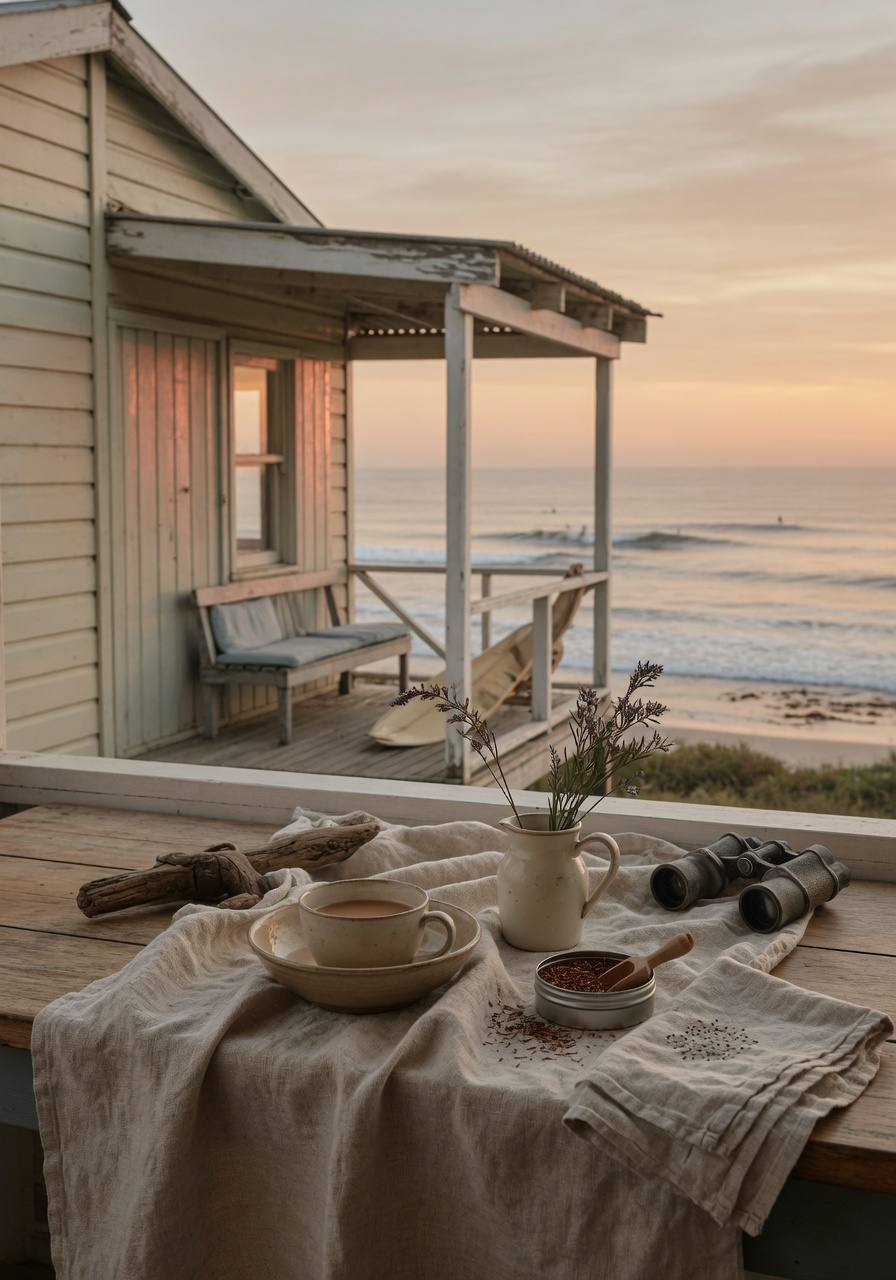
A weatherboard cabin above the J-line at Jeffreys Bay — old-Cape porch, a tea bench facing the point, and a *Dāncōng* (单丛) oolong programme led by Mei Yang for dawn-patrol mornings.
A weatherboard cabin on the J-line
Cango cabin sits on the bluff above the J-line — close enough that the second swell of the morning arrives as a sound before it arrives as a sight. The house is small and quiet: two bedrooms under a pitched corrugated roof, a kitchen of seasoned yellowwood, a porch deep enough for a long bench and a low table. Most mornings begin there. The porch faces south-east toward Supertubes, and the light comes in flat and grey before it turns gold, and the steam from the first kettle drifts across the rail and is taken inland on the offshore wind.
The cabin sleeps four across two rooms. The main bedroom opens onto the porch through a single sash window; the second is tucked behind the kitchen, cooler, with a view across the dune scrub. Floors are old fynbos pine, oiled, salt-scuffed in the way that only houses near a working point ever are. There is no television. There is a small library — surf logs from the 1980s, a battered copy of Kynaston’s South African Surfing Spots, three notebooks left by previous guests with wave counts and tea notes. Wetsuits hang on the side of the house under a tin overhang; boards live on a rack in the porch corner, fins toward the wall.
The tea room is the porch itself in good weather and the front parlour when the wind turns onshore. Four seats around a low yixing-friendly table — a slate slab on reclaimed stinkwood — with a brass kettle on a small gas ring and a draining board cut from a single piece of driftwood. Mei Yang, the in-residence master, keeps her working set here: three gāiwǎn (盖碗), a row of small Cháozhōu (潮州) clay pots for the Dāncōng programme, and a wooden tea boat that has crossed the equator twice. She writes regularly for puerh.app on the question of how oolong travels — what humidity does to Mí Lán Xiāng (蜜兰香) on a long ship from Shantou to Cape Town — and her own roasting notes appear from time to time on tea.school.
Mei’s daily routine sets the tempo of the house. She wakes before the guests, usually around 04:50, and lights the kettle for her own first session — a quiet Yā Shǐ Xiāng (鸭屎香) brewed neat at the porch table while the point is still in shadow. Guests rise as they will. The first guest session is timed to the morning ride at Supertubes — generally around 06:15 in winter, earlier in summer — and runs for thirty-five minutes on the porch: a short pre-surf cup, no food, the conversation kept low. After the session, boards go down the path through the milkwoods to the water, and the kettle is set aside.
The second session is in the late morning, after the surf, when the wetsuits are draining on the rail and the guests are warm again. This is the longer one — sixty to ninety minutes, depending on the cultivar and the mood — and Mei moves through the Dāncōng line in deliberate order. A third session, optional, runs at dusk for those who want it; the porch lamp is a single brass hurricane that throws a small circle of light onto the slate.
The surrounding environment is the J-Bay one already knows from the videos — Supertubes, Boneyards, Impossibles, all within a fifteen-minute walk on the dune path — but the cabin sits above the noise of the main strip. The dunes south of the house are protected fynbos; in spring the Erica comes into flower and the porch smells faintly of honey on the offshore. Dolphins move past the point most mornings. The nearest restaurant is a ten-minute walk; most guests cook for themselves, which is what the kitchen was built for. We list Cango alongside the rest of the surf collection on tea.travel, and the cabin’s tea programme is part of the broader oolong work catalogued on thetea.app.
Mei Yang’s Dāncōng programme
The tea served at Cango is Dāncōng (单丛) oolong from the Phoenix Mountains of eastern Guangdong — the single-bush teas Mei Yang has worked with for the better part of two decades. The cabin holds a working library of eleven cultivars at any given time, drawn from her growers in Wūdòng (乌岽) and the mid-altitude Lǐrén (李仔坪) gardens, with the roasting profiles adjusted seasonally for the South Cape humidity.
The programme runs in three sessions a day. The pre-surf session, short and aromatic, leans on the higher-floral cultivars — Mí Lán Xiāng (蜜兰香), honey-orchid, and Yù Lán Xiāng (玉兰香), magnolia — brewed lightly in a gāiwǎn and served in two small cups. The intention here is alertness without weight. Caffeine and L-theanine are present in the proportions oolong gives them, but the volume of liquid is small and the body is not loaded before the water. Mei discusses the science of this pairing in her column on tea.energy; at the cabin she simply pours it.
The post-surf session is the centre of the programme and the reason most guests come. This is when Mei brings out the Cháozhōu (潮州) clay — small red pots, each kept for a single cultivar — and the heavier-roasted Dāncōng enter the table. Yā Shǐ Xiāng (鸭屎香), the duck-shit fragrance, mineral and long; Xìng Rén Xiāng (杏仁香), almond, with the slightly bitter finish that suits a body that has been in cold water for two hours; and Dōng Fāng Hóng (东方红), an aged cultivar Mei roasts herself in Shantou and ships through Cape Town once a year. Brewing is gōngfū — first infusion fifteen seconds, then the careful descending curve — and a session typically runs nine to twelve steeps over an hour.
The optional dusk session is quieter and often turns to hóngchá (红茶), Mei’s secondary specialism — a Jīn Jùn Méi (金骏眉) or a smoky Lapsang Souchong from the original Tongmu village, depending on the weather and the company. Sessions are limited to four guests; if the cabin is taken by two, the sessions are private and the pace slows accordingly. Guests who want to continue the work at home can carry away a small selection of cultivars sourced through shop.thetea.app and shop.puerh.app, packed by Mei in unmarked tins.
Amenities
-
Two bedrooms, sleeps four, single bathroom with outdoor rinse shower
-
Deep south-facing porch with tea bench and slate table
-
Yellowwood kitchen, gas range, full equipment for self-catering
-
Board rack and wetsuit rail under tin overhang
-
Direct dune path to Supertubes and Boneyards, five minutes on foot
-
Surf library and a small reading collection on Cape natural history
-
Offshore-protected fynbos garden, no through traffic
-
Resident tea master in attendance during stays
What’s included
-
Three daily tea sessions led by Mei Yang on a programme tuned to the surf day
-
Full working selection of Dāncōng (单丛) cultivars plus a rotating hóngchá (红茶) line
-
Pre-arrival surf and swell briefing for the dates booked
-
Wax, towels, and rinse-off facilities for two boards per guest
-
Tea notes journal kept for each stay, returned on departure
-
Optional pickup from Port Elizabeth, ninety minutes by road